
Tiny bubbles or pinholes after lamination? Here is the field checklist most laminator operators use to find the real cause — usually dust, adhesive, temperature, or humidity, not the film.
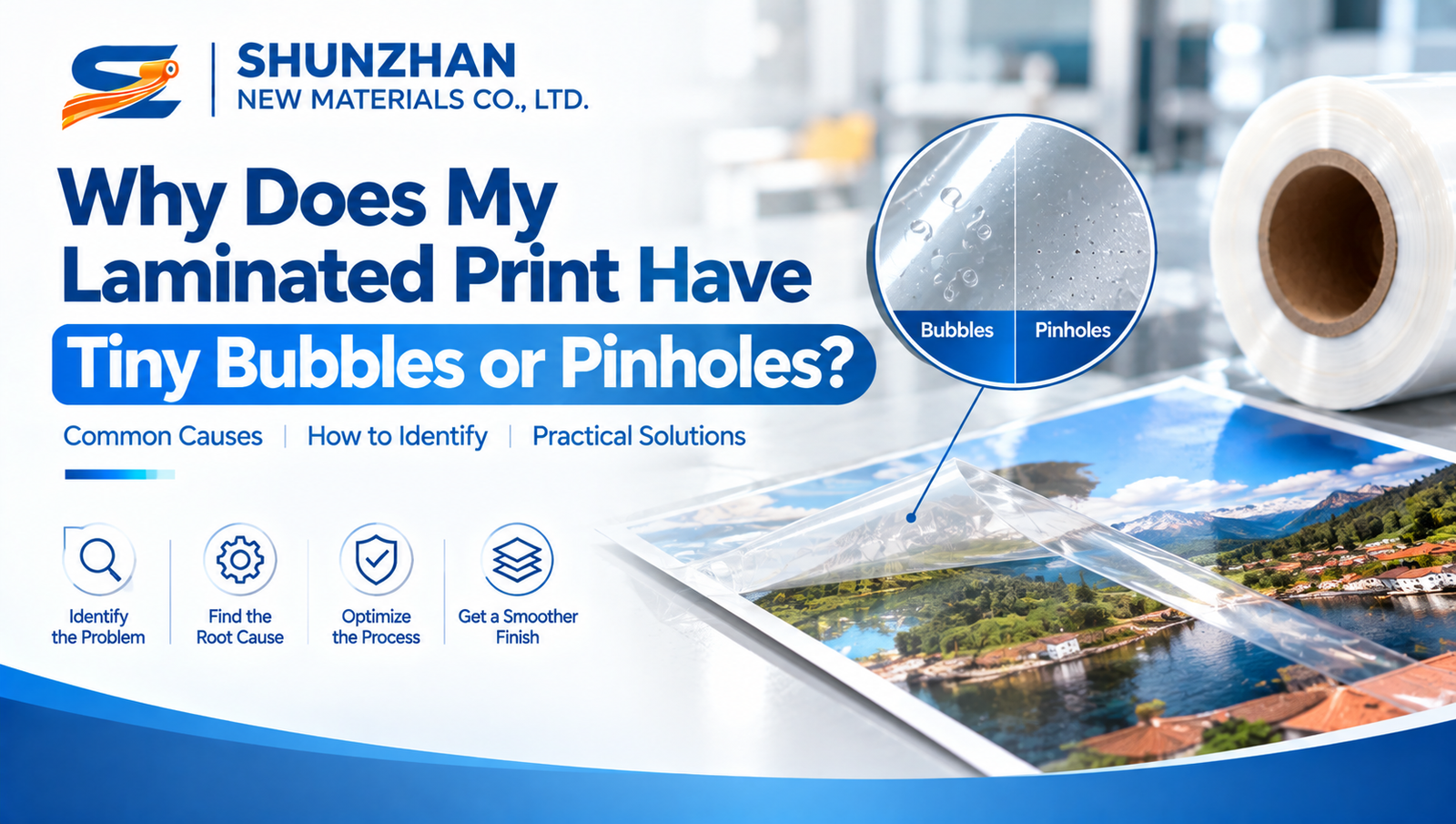
Bubbles vs. Pinholes — Why the Difference Matters
A bubble is a pocket of trapped air or gas between the film and the substrate. It usually has a visible diameter, can sometimes be rubbed flat, and tends to cluster along edges or where the adhesiv…
1. Dust on the Film Surface
Film stored near a cutting table, near an open door, or handled without gloves picks up airborne dust. When the adhesive meets the dust, the dust acts as a tiny spacer and traps a pocket of air.
2. Adhesive Not Fully Wetting Out
If the adhesive is too cold, too thick, or applied too thinly, it does not flow into the micro-roughness of the substrate. Air stays trapped.
4. Nip Temperature Too Low
A cold nip does not give the adhesive enough energy to flow and de-air. Most EVA-based laminating adhesives need 90°C to 110°C to wet out cleanly.
5. Nip Pressure Too Light
Without enough pressure, air stays between the layers. A 5–10% increase in pressure often clears the problem immediately.
6. Machine Speed Too Fast
Faster lines need more heat to compensate. If your line is running at the upper end of its speed range, bubbles tend to appear first on the trailing edge of the sheet.
7. Film Tension Imbalance
Wrinkles cause air pockets. Consistent winding tension in the film roll matters more than people think — a poorly wound roll with slack on one side will feed unevenly and leave air pockets behind t…
The 60-Second Field Checklist
Before you call your film supplier, walk through these: Wipe the film surface with a clean, lint-free cloth before unwinding. Check that your adhesive bath is at the supplier-recommended temperature.
When to Blame the Film vs. the Process
A consistent BOPP film — uniform thickness, smooth surface, stable winding tension — keeps the variables down. Where film quality contributes to bubble formation, it usually shows up as a systemic…
Key takeaway
The cheapest bubble is the one that never forms. A few habits that pay back quickly: Store film in a clean area away from cutting and slitting operations. Condition paper substrates to 23°C / 50% RH before lamination. Keep adhesive temperature stable — do not let the bath cool down overnight. Train operators to recognize early signs (matte patches, squealing nip).
Request free film samples or send your specification — we reply with a quotation within 24 hours.