
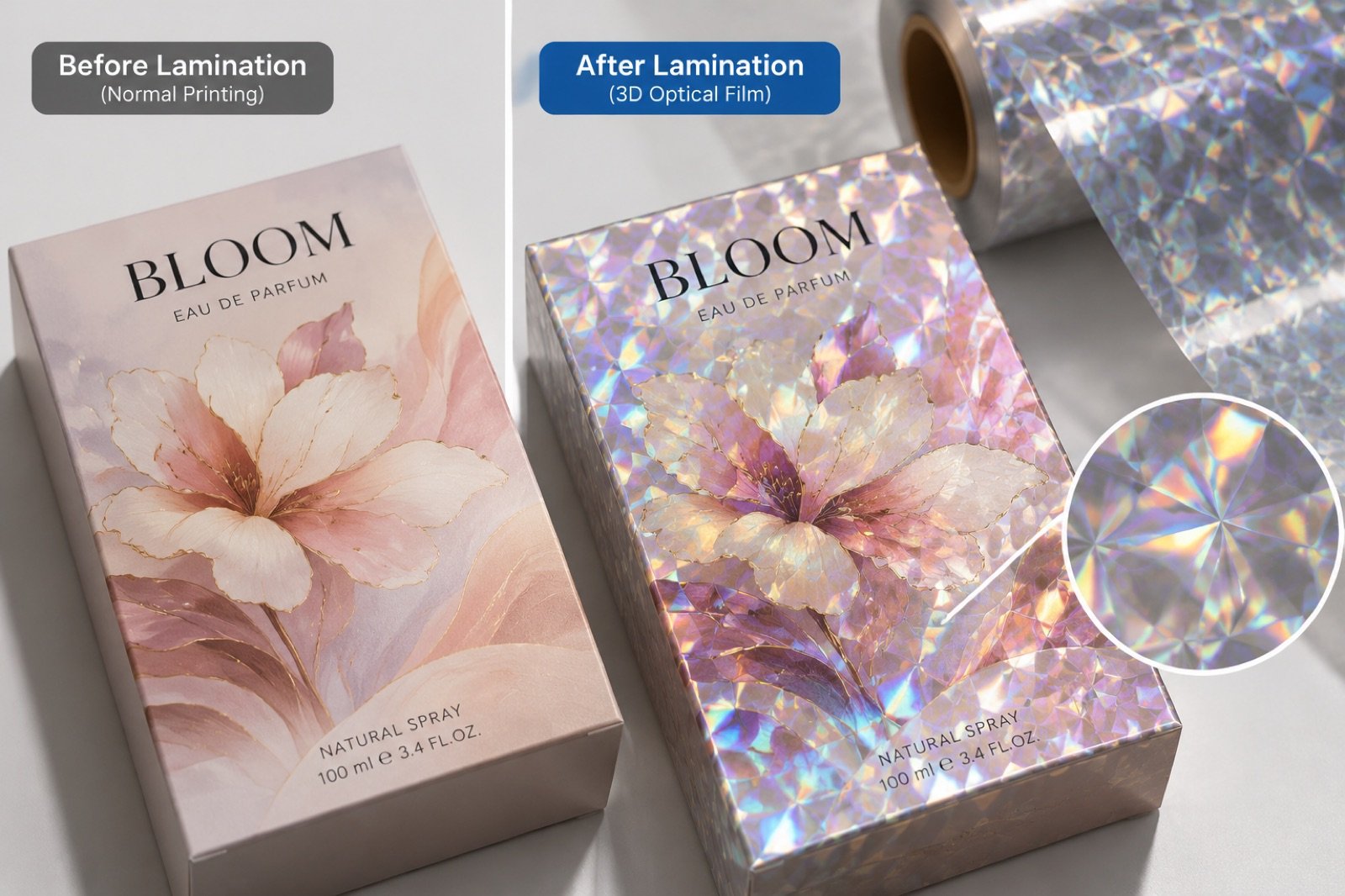
3D PET laminating film is used to give printed surfaces a more vivid, dimensional appearance. Instead of leaving a plain glossy finish, its optical patterns catch and redirect light, creating shifting
3D PET laminating film is used to give printed surfaces a more vivid, dimensional appearance. Instead of leaving a plain glossy finish, its optical patterns catch and redirect light, creating shifting highlights, rainbow reflections and a sense of depth as the viewing angle changes.
How 3D PET Laminating Film Creates Depth and Dimension
3D PET laminating film is used to give printed surfaces a more vivid, dimensional appearance. Instead of leaving a plain glossy finish, its optical patterns catch and redirect light, creating shift…
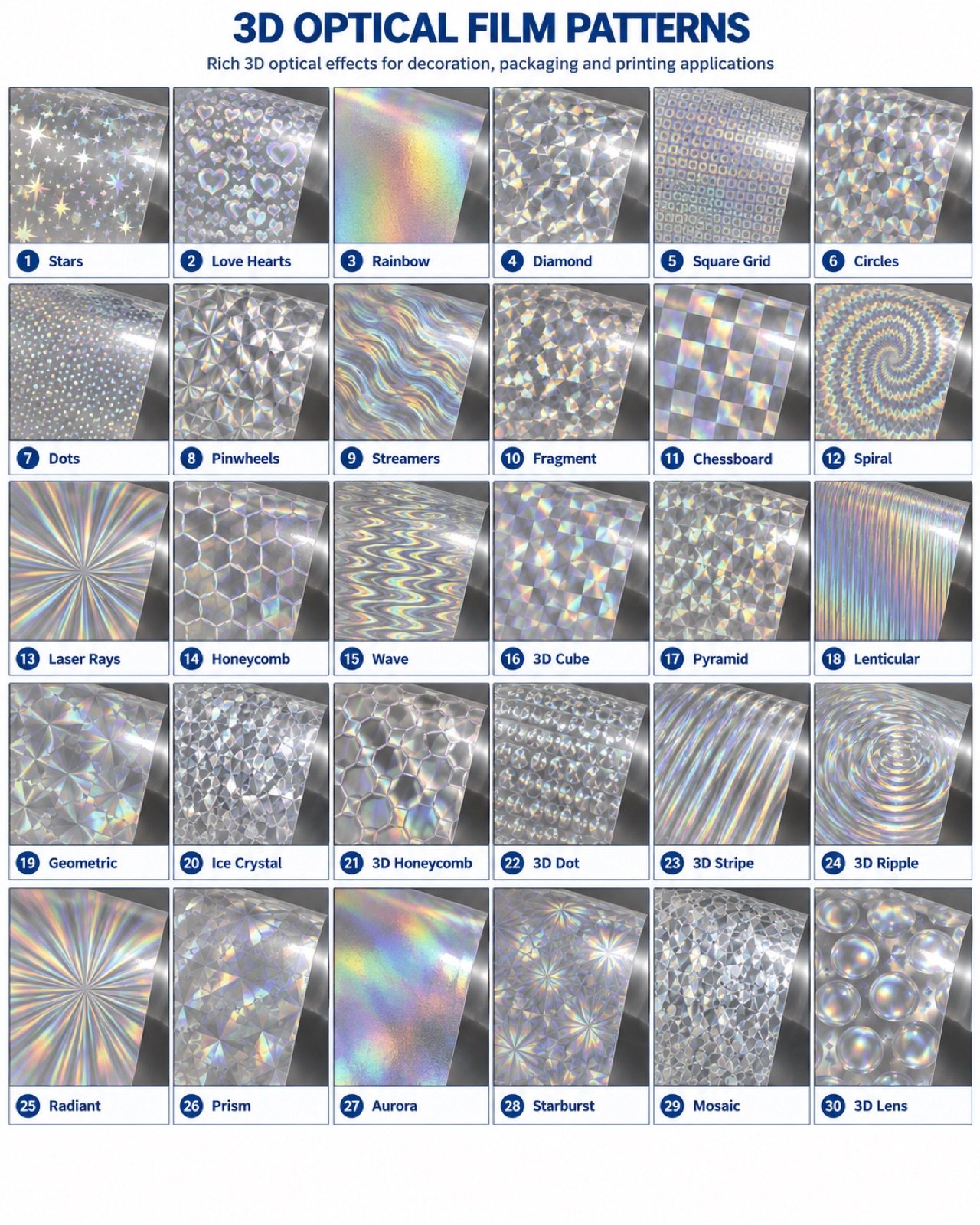
Diamond, prism and geometric patterns
These patterns use repeated angular facets to create a crystalline, cut-glass look. They work well when the design needs a premium, technical or high-impact finish, especially on gift boxes, cosmet…
Rainbow, aurora and holographic patterns
These patterns show shifting spectral colours under light. They can make large areas feel bright and lively, but the printed artwork underneath should be designed carefully so that the reflective e…
Wave, ripple and stripe patterns
Curved lines and directional textures create a sense of motion. They are useful for modern graphic designs, covers and packaging where the finish should feel energetic or fluid.
Stars, dots, hearts and other decorative motifs
Recognisable motifs offer a more playful look for seasonal packaging, stationery, greeting cards, children’s products and gift items. Pattern scale matters: fine motifs can look delicate, while lar…
How to choose the right pattern
Match the pattern to the artwork. Avoid placing the strongest optical pattern behind small text or detailed logos.
Processing considerations
Before ordering, confirm the film thickness, roll width, surface pattern, compatible laminating method and intended substrate with the supplier. The film should be evaluated on the actual paper or…
Is 3D PET laminating film the same as lenticular film? — Not necessarily. Many 3D PET laminating films use embossed optical or holographic patterns to create changing reflections. Lenticular film uses a specific lens structure to show different image views at different angles. Confirm the product construction with the supplier.
Does the film create a 3D effect under normal lighting? — Patterned reflections are generally visible under ordinary lighting, but the strength and colour shift depend on the pattern, light direction and viewing angle.
Key takeaway
3D PET laminating film creates visual depth through patterned optical reflections—not necessarily through a lens array or a moving image. Choosing the right pattern helps printers and packaging converters add dimension, shine and shelf appeal while keeping the printed design readable. For 3D PET decorative film patterns and finishing options, contact Shandong Shunzhan New Materials at www.szbopp.c
Request free film samples or send your specification — we reply with a quotation within 24 hours.
Frequently Asked Questions
How 3D PET Laminating Film Creates Depth and Dimension?
3D PET laminating film is used to give printed surfaces a more vivid, dimensional appearance. Instead of leaving a plain glossy finish, its optical patterns catch and redirect light, creating shifting highlights, rainbow reflections and…
What buyers should know about diamond, prism and geometric patterns
These patterns use repeated angular facets to create a crystalline, cut-glass look. They work well when the design needs a premium, technical or high-impact finish, especially on gift boxes, cosmetics packaging, book covers and promotion…
What buyers should know about rainbow, aurora and holographic patterns
These patterns show shifting spectral colours under light. They can make large areas feel bright and lively, but the printed artwork underneath should be designed carefully so that the reflective effect supports rather than overwhelms th…
Is 3D PET laminating film the same as lenticular film?
Not necessarily. Many 3D PET laminating films use embossed optical or holographic patterns to create changing reflections. Lenticular film uses a specific lens structure to show different image views at different angles. Confirm the product
Does the film create a 3D effect under normal lighting?
Patterned reflections are generally visible under ordinary lighting, but the strength and colour shift depend on the pattern, light direction and viewing angle.